Contact us!

Call / message / whatsApp/ me
@
9447820161
or mail me
Showing posts with label Yugoslavia. Show all posts

Tuesday, January 20, 2026

5 Surprising Truths About Yugoslavia, The Country That Vanished From The Map

Maps are meant to be permanent, but history has a way of erasing borders. No 20th-century nation vanished more suddenly and violently than Yugoslavia, a country that existed for most of the century before being wiped from the map. Beyond the headlines of its collapse, its 74-year history is a complex story filled with counter-intuitive realities. Here are five of the most impactful truths about the "Land of the South Slavs."


1. It Existed in Two Radically Different Forms Before Its Collapse

Many associate Yugoslavia with the socialist state that emerged after World War II, but that was actually its second iteration. The first, originally called the Kingdom of Serbs, Croats, and Slovenes, was forged in the aftermath of WWI. This first Yugoslavia was less a nation of shared dreams and more a pressure cooker of rival identities, held together by a king's iron fist.

In 1929, seeking to crush deep-seated ethnic tensions, King Alexander I renamed the country the Kingdom of Yugoslavia and established a "royal dictatorship." The era was defined by brutal instability, highlighted by the 1928 assassination of Croatian leader Stjepan Radić in parliament and the subsequent assassination of King Alexander I himself in 1934. This violent attempt to force unity ultimately failed when the Kingdom collapsed after being invaded and partitioned by Axis powers in 1941. Its destruction was a grim precursor to the more sophisticated, but equally fragile, system Josip Broz Tito would later build to solve the same problem.

2. It Was The Communist State That Defied Moscow

Despite being a communist-led state under its longtime leader Josip Broz Tito, Yugoslavia was fiercely independent and refused to fall in line with the Soviet Union. This was exceptionally rare in Cold War-era Europe.

The pivotal moment came with the 1948 split with Stalin's Soviet Union, a shocking act of defiance that isolated Yugoslavia from the Eastern Bloc. Instead of choosing a side, Tito's government helped forge a different path. It became a founding leader of the Non-Aligned Movement, positioning itself as a powerful alternative for nations that refused to be drawn into the binary conflict between the United States and the USSR.

In a world starkly divided by the Iron Curtain, Yugoslavia forged a third path, proving that a communist state could refuse to be a Soviet puppet.


3. Its Famous Unity Was More Fragile Than It Looked

Tito held the complex, multi-ethnic federation together under the official state policy of "Brotherhood and Unity." This motto was intended to foster a common Yugoslav identity over the distinct national identities of its peoples, which included Serbs (predominantly Orthodox), Croats (Catholic), Slovenes (Catholic), and Bosniaks (Muslim), among others.

However, this unity was largely dependent on Tito's central authority. After his death in 1980, the forces he had suppressed began to re-emerge. A severe economic crisis and massive national debt in the 1980s created fertile ground for the rise of nationalism, championed by figures like Serbian leader Slobodan Milošević who stoked ethnic grievances for political gain. The famous "Brotherhood and Unity" was revealed to be more of a lid on a boiling pot of historical rivalries than a permanent solution to them.

4. The Breakup Wasn't an Event; It Was a Long, Slow Dissolution

It's a common misconception that Yugoslavia simply ended in 1991. In reality, the country's disappearance was a painful, drawn-out process that spanned nearly two decades.

The disintegration began in 1991-1992 as the republics of Slovenia, Croatia, Macedonia (today North Macedonia), and Bosnia and Herzegovina declared independence. This triggered the devastating Yugoslav Wars, the deadliest conflicts in Europe since WWII, which were characterized by ethnic cleansing and the Srebrenica genocide and lasted until 2001. Even then, a "rump" state of Serbia and Montenegro continued to call itself Yugoslavia until 2003. The final pieces fell away much later, with Montenegro becoming independent in 2006 and Kosovo declaring its independence from Serbia in 2008.


5. From One Nation, Seven Emerged

The final outcome of Yugoslavia's long dissolution was the creation of seven independent nations on its former territory. These countries are Slovenia, Croatia, Bosnia and Herzegovina, Serbia, Montenegro, North Macedonia, and Kosovo.

It is important to note that Kosovo's status is partially recognized on the international stage. These seven states emerged from the administrative structure of Tito's Yugoslavia: a federation of six constituent republics (Slovenia, Croatia, Bosnia and Herzegovina, Serbia, Montenegro, and Macedonia) and two autonomous provinces within Serbia (Kosovo and Vojvodina). What was once a single, unified country is now a mosaic of sovereign states, each with its own distinct identity.

The Enduring Echoes of a Lost Nation

Yugoslavia’s story is a complex lesson in formation, reinvention, and fragmentation. Its history shows how a nation can be built on an ideal, held together by a strong will, and ultimately torn apart by the very historical forces it sought to overcome. How do the ghosts of a vanished nation continue to shape the identities and politics of the countries that replaced it?


Tuesday, July 1, 2025

Yugoslav Currencies: 1900–2000

 A Century of Change Reflected Through Coin and Currency

This document provides an overview of the currencies used in the region that constituted Yugoslavia from the early 20th century through its dissolution and the emergence of successor states. It covers the currencies used before the formation of Yugoslavia, the various iterations of the Yugoslav dinar, transitional currencies, and the currencies that emerged after the breakup, focusing on the Serbian dinar. The narrative highlights the economic and political changes reflected in the monetary policies and designs of the currencies.

🇦🇹 Before Yugoslavia (pre-1918)

Prior to the formation of Yugoslavia in 1918, the region was under the control of various empires and kingdoms, each with its own monetary system. Areas such as Slovenia, Croatia, and Bosnia, which were part of the Austro-Hungarian Empire, used the Austro-Hungarian Krone (Kronen). This currency was the standard for much of Central Europe and reflected the economic influence of the Habsburg monarchy.

Meanwhile, Serbia, an independent kingdom, utilized its own Serbian dinar. The Serbian dinar was often pegged to the French franc, indicating Serbia's economic ties and alignment with Western European financial standards.

🏛️ The Birth of Yugoslavia (1918)

In 1918, following the end of World War I, the Kingdom of Serbs, Croats, and Slovenes was formed, uniting several South Slavic regions. This new kingdom was later renamed the Kingdom of Yugoslavia in 1929, marking a significant shift in the political landscape of the Balkans.


💰 1. Yugoslav Dinar (1918–1941)

To establish economic unity within the newly formed kingdom, the Yugoslav dinar was introduced as a unified currency. This currency was intended to replace the regional coins and banknotes that had been in circulation prior to unification.

Early banknotes and coins of the Yugoslav dinar featured royal figures, most notably King Peter I and King Alexander I. These depictions served to legitimize the new monarchy and foster a sense of national identity among the diverse populations of the kingdom.

Initially, the Yugoslav dinar was pegged to the French franc. This decision was aimed at stabilizing the currency and integrating it into the international monetary system. The dinar served as the primary currency of Yugoslavia until the Axis invasion in 1941, which brought about significant economic and political upheaval.

🪙 2. Yugoslav Kruna (1919 – transitional)

In the immediate aftermath of World War I, a transitional currency known as the Yugoslav Kruna was briefly used in Slovenia and Croatia. This currency was created by overprinting Austro-Hungarian Krone banknotes with the designation "Yugoslav Kruna."

The Yugoslav Kruna served as a stopgap measure until the Yugoslav dinar could be fully implemented and distributed throughout the newly unified territories. Its use was limited and temporary, reflecting the challenges of establishing a unified monetary system in the wake of significant political change.

⚔️ 3. Partisan Dinar (1941–1945)

During World War II, Yugoslavia was occupied by Axis forces, leading to the emergence of resistance movements. The Yugoslav Partisans, led by Josip Broz Tito, issued their own currency in liberated areas. This currency, known as the Partisan dinar, symbolized resistance and administrative independence from the Axis powers.

The Partisan dinar is considered rare and valuable by collectors today, as it represents a unique chapter in Yugoslav history. Its issuance demonstrated the Partisans' commitment to establishing an alternative government and economy in opposition to the occupying forces.

🛠️ 4. Federation Dinar (1944–1965)

Following World War II, the Socialist Federal Republic of Yugoslavia was established under the leadership of Josip Broz Tito. This new socialist state introduced the Federation Dinar as its official currency.


The Federation Dinar featured imagery that reflected the socialist ideology of the time, including depictions of workers, farmers, and communist symbols. These designs were intended to promote a sense of unity and solidarity among the diverse ethnic groups within Yugoslavia.

However, the Federation Dinar experienced persistent inflation, which led to several revaluations over its lifespan. These revaluations were attempts to stabilize the economy and maintain the currency's value in the face of economic challenges.

💎 5. Hard Dinar (1966–1989)

In 1966, a major monetary reform was implemented in Yugoslavia, resulting in the introduction of the Hard Dinar. This reform involved revaluing the currency at a rate of 100 old dinars to 1 new (hard) dinar.

The Hard Dinar was designed to stabilize the economy and curb inflation, which had been a persistent problem with the previous currency. Coins included lower denominations like 1, 2, and 5 dinars, often featuring state emblems.

Initially, the Hard Dinar proved successful in stabilizing the economy. However, inflation returned in the late 1980s, undermining the currency's stability and contributing to economic instability.

🔁 6. Convertible Dinar (1990–1992)

In a final attempt to modernize its economy, Yugoslavia introduced the Convertible Dinar in 1990. This currency was aimed at aligning with international markets and reducing inflation.


However, the Convertible Dinar was short-lived due to the breakup of Yugoslavia and the ensuing economic collapse. The dissolution of the socialist federation into several independent countries marked the end of a unified monetary system.

💥 Breakup and Hyperinflation (1992–1994)

The early 1990s were marked by the violent breakup of Yugoslavia, as the socialist federation dissolved into several independent countries. The remaining Federal Republic of Yugoslavia, consisting of Serbia and Montenegro, faced severe economic challenges, including hyperinflation.

During this period, the Federal Republic of Yugoslavia issued several iterations of the dinar, including the 1992 Dinar and the 1993 Dinar. The 1993 Dinar reached astronomical levels of inflation, with exchange rates soaring to 500 billion dinars per USD.

In 1994, the Novi Dinar was introduced and pegged to the Deutsche Mark in an attempt to stabilize the currency and restore confidence in the economy.

🇷🇸 7. Serbian Dinar (2000 onwards)

In 2000, the Novi Dinar was still in use in Serbia. The currency transitioned to the modern Serbian dinar (RSD) by 2003. The Serbian dinar remains the official currency of Serbia today, reflecting the country's economic independence and sovereignty.

Wednesday, June 18, 2025

🇷🇸 Federal Republic of Yugoslavia: A Forgotten Chapter in Balkan History

The Federal Republic of Yugoslavia (FR Yugoslavia) holds a unique and complex place in the modern history of Europe. Established in 1992, it emerged from the ashes of the disintegrating Socialist Federal Republic of Yugoslavia, a nation once composed of six republics. After the secession of Croatia, Slovenia, Bosnia & Herzegovina, and Macedonia, only Serbia and Montenegro remained, forming the FR Yugoslavia.


A Nation Born in Turmoil

FR Yugoslavia came into being during one of the most politically volatile periods in the Balkans. It faced immediate international sanctions, economic hardships, and a series of wars, most notably in Bosnia and Kosovo. These conflicts severely impacted its global standing and domestic stability. Despite its name, the Federal Republic was not recognized as the legal successor to the original Yugoslavia by the United Nations until much later.

Economic Crisis and Currency Struggles

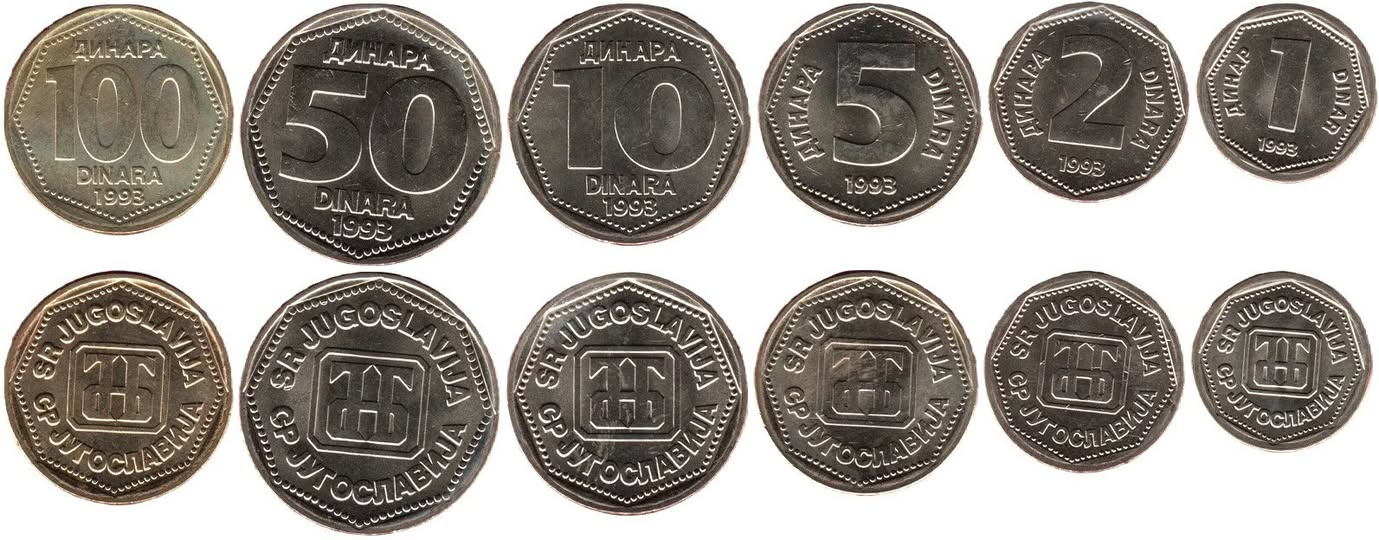
One of the defining challenges of this period was hyperinflation. The economy of FR Yugoslavia went through multiple phases of monetary collapse, leading to the frequent revaluation of the Yugoslav Dinar. In 1993, the government issued new sets of coins in denominations of 1, 2, 5, 10, 50, and 100 Dinara, with diameters ranging from 18 mm to 26 mm. These coins, although short-lived in circulation, have become historical artifacts reflecting a time of economic desperation and transition.

The End of Yugoslavia

In 2003, the FR Yugoslavia was officially restructured and renamed Serbia and Montenegro, signaling the end of the "Yugoslavia" name. Finally, in 2006, Montenegro voted for independence, and the last vestiges of the Yugoslav identity were dissolved.

Legacy and Collectibility

Today, the 1993 Dinara coin sets from the Federal Republic of Yugoslavia are sought-after collectibles. They represent more than just currency — they tell the story of a nation struggling to redefine itself amid war, economic collapse, and shifting identities.

For history buffs and coin collectors alike, these coins offer a tangible connection to one of Europe’s most turbulent political transitions.


Looking to add this unique piece of Balkan history to your collection? The 1993 FR Yugoslavia 6-coin set is available now — uncirculated, with minor contact marks, and full of historical significance.

#Yugoslavia #FederalRepublic #1993Coins #YugoslavDinara #SerbiaMontenegro #Numismatics #CoinCollectors #BalkanHistory #HyperinflationCoins #OldCurrency #HistoricCoins

Sunday, June 7, 2015

Collection of 12 Coins from YugoslaviaPara - Dinar - Dinara

 Collection of 12 Coins from Yugoslavia
Para - Dinar - Dinara
Very Rae Collection
Very Fine Grade Coins

Tuesday, April 21, 2015

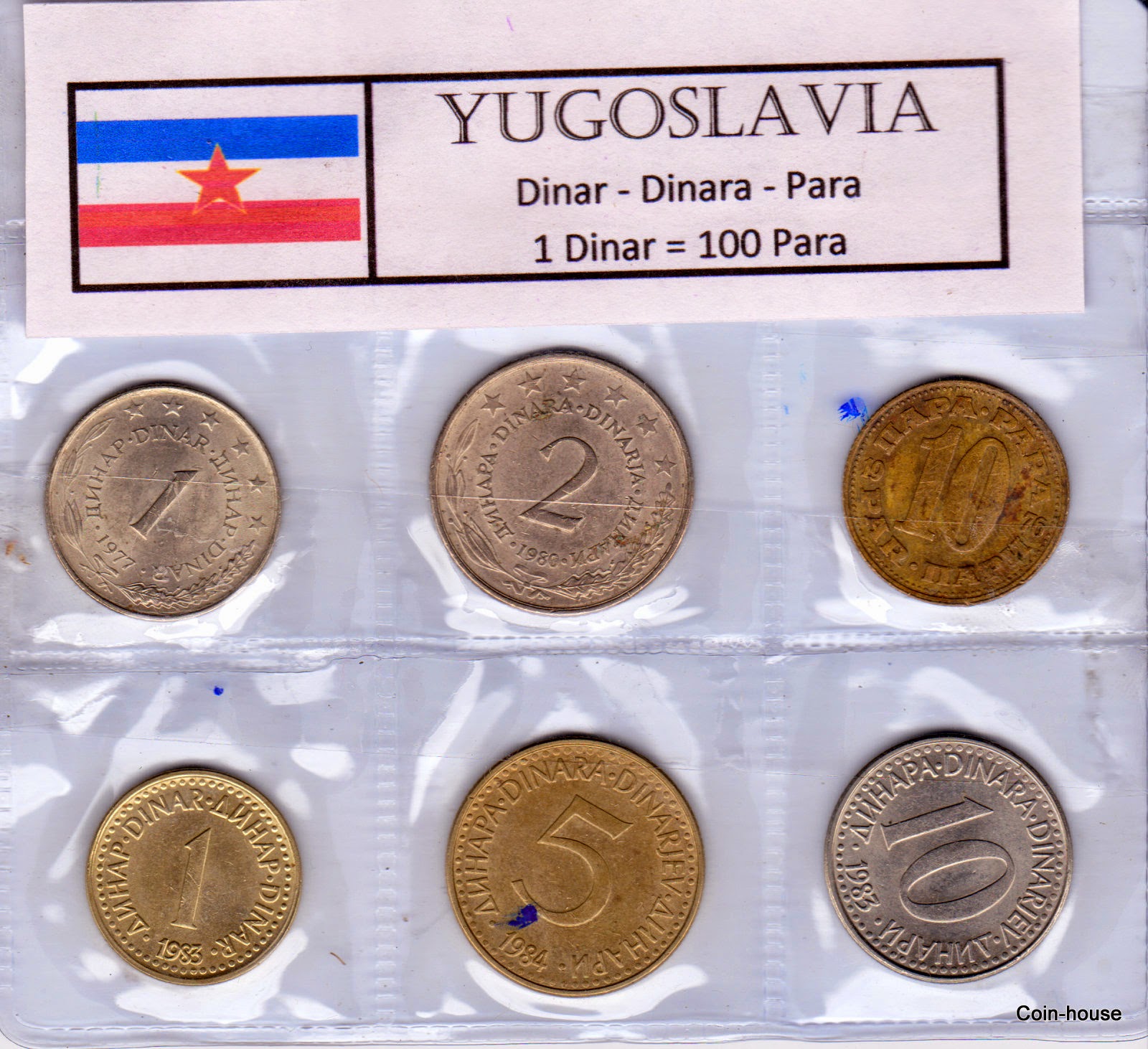
Collection of 6 coins from Yugoslavia, XF Grade

Collection of 6 coins from Yugoslavia, XF Grade
Yugoslavia - Collection of 6 Coins
Dinar - Dinara & Para
6 Dinar = 100 Para

On November 13, 2000, the dinar was dropped and the Deutsche Mark (by that time defined in terms of the euro) became the only currency. In 2003, the end of Yugoslavia led to the dinar, by then only used in Serbia, being replaced at par by the Serbian dinar.

Saturday, April 18, 2015

6 Coins from Yugoslavia - Para - Dinar - Dinara

The Socialist Federal Republic of Yugoslavia was the Yugoslav state that existed from its foundation in the aftermath of World War II until its dissolution in 1992 amid the Yugoslav Wars.

Contact Us!

Call / message / whatsApp/ me @ 9447820161 or mail me goldenweblinks@gmail.com

The Costa Rican Colón: A Journey Through History, Nature, and Local Slang

If you are planning a trip to Costa Rica or simply have a passion for numismatics, the local currency offers a fascinating window into the c...

Most Popular